Zoological Survey Record
Scanner-Preserved Data
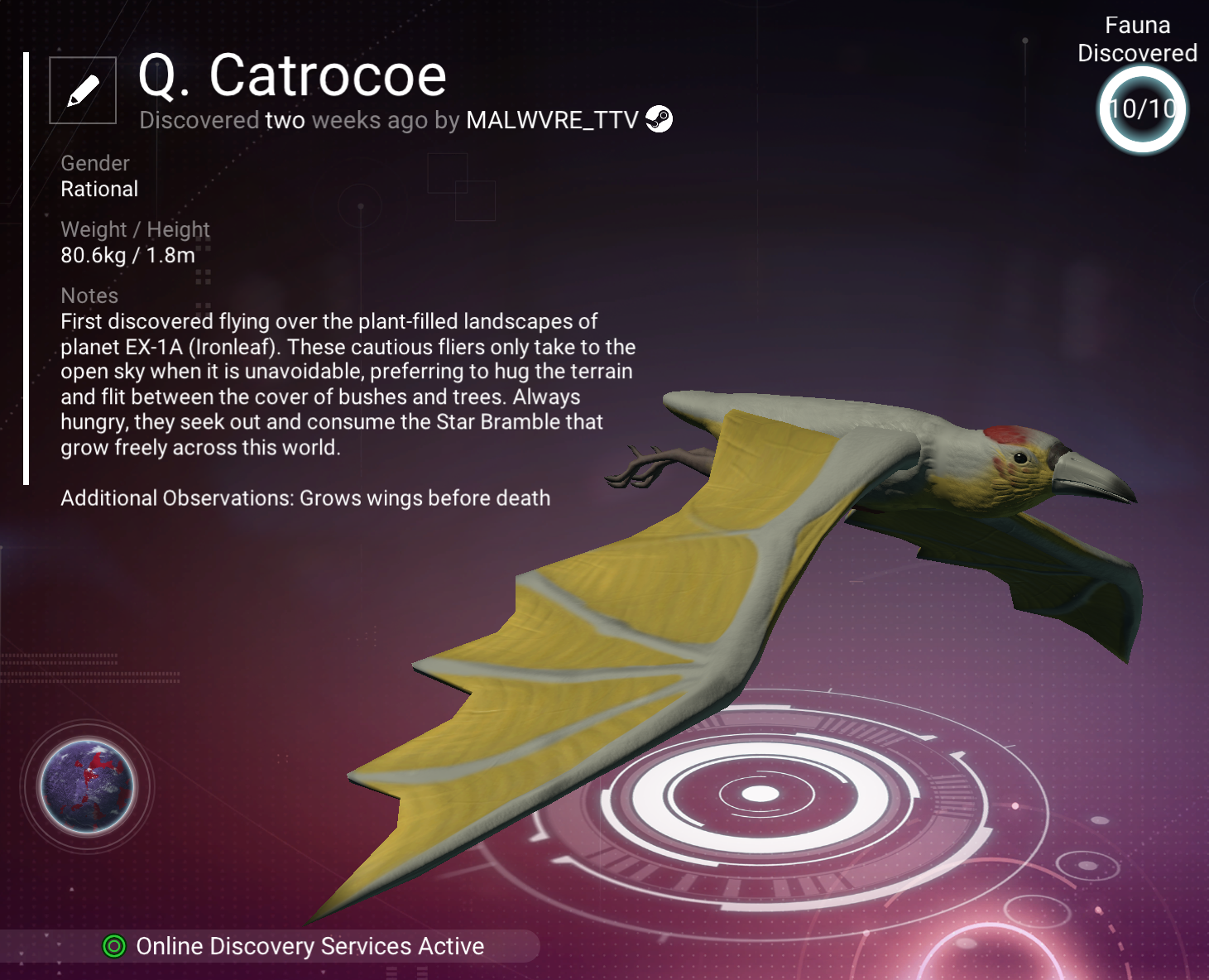
First recorded flying over the plant-filled landscapes of Ironleaf. The preserved scanner record describes cautious fliers that avoid unnecessary exposure to open sky, remaining close to terrain and moving between bushes and trees. The scanner further reports persistent feeding on Star Bramble growing across the world. Additional scanner observation: grows wings before death.
Morphological Description
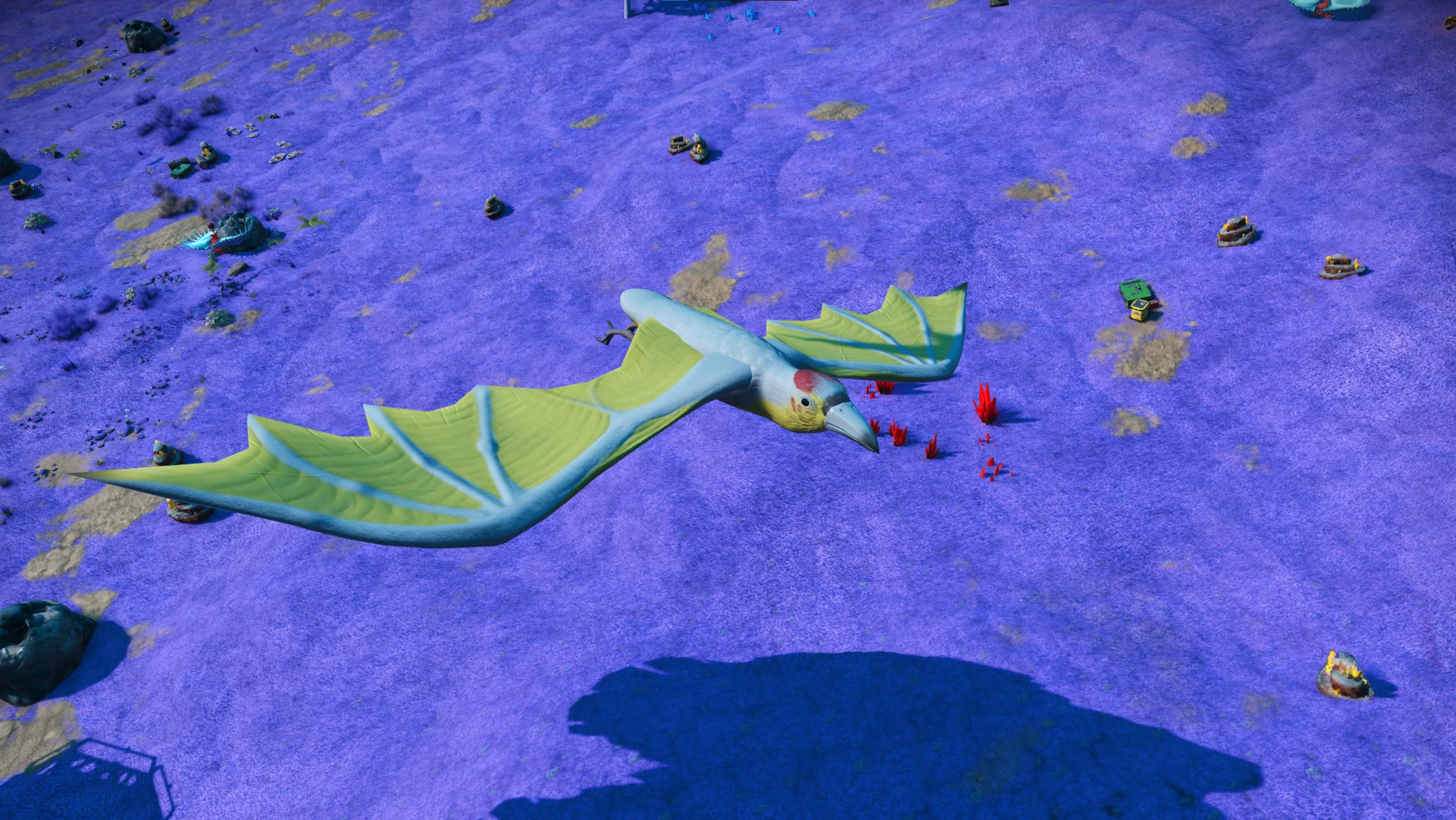
Field photography documents a large winged organism with broad, tapered wings supported by pale structural ribs and yellow-green membranes. The body is predominantly pale, with a yellow throat and a red crown marking. A long, pointed beak projects forward from the head. The organism was photographed in sustained low-altitude flight above Ironleaf’s violet surface.
Behavioral Observation
A small group of three winged creatures was observed travelling in a tightly grouped formation at a leisurely pace. Individual animals periodically broke away from the group, but the formation repeatedly reassembled as flight continued. Nearby aerial creatures produced no obvious alarm or avoidance response; the group appeared largely unbothered by their presence. This observation was recorded during a later targeted observatory mission and is preserved separately from the original reconnaissance discovery.
Behavioral Context
The later field observation supports a picture of Q. Catrocoe as a social aerial organism capable of maintaining loose group cohesion while in flight. Periodic separation followed by reformation suggests that the observed group was coordinated without remaining rigidly clustered.
The scanner’s description of cautious, terrain-hugging flight is retained alongside the observatory record rather than reconciled into a single conclusion. The observed animals were relaxed in the presence of other aerial fauna, but one encounter is insufficient to determine whether this tolerance is typical, situational, or dependent on environmental conditions.
Outstanding Zoological Questions
- Whether tightly grouped flight is typical social behavior or specific to the observed group.
- Conditions that cause individuals to break formation and subsequently regroup.
- How the scanner-reported preference for terrain cover varies across open terrain and different flight conditions.
- Nature of the reported feeding relationship with Star Bramble.
- Biological meaning of the scanner observation “Grows wings before death.”
Archive Significance
Q. Catrocoe restores the missing discrete record for Ironleaf’s tenth authenticated fauna biosignature. The species was already represented in the completed orbital inventory and ecological assessment; this entry restores its individual archival record without altering the established 10 / 10 fauna total.
Preservation Justification
Retained as a restored zoological record supported by the original reconnaissance scanner capture and later targeted field documentation. The archive preserves the separation between discovery evidence and subsequent observation so that the provenance of each evidentiary layer remains explicit.