Botanical Survey Record
Scanner-Preserved Data
Morphological Description
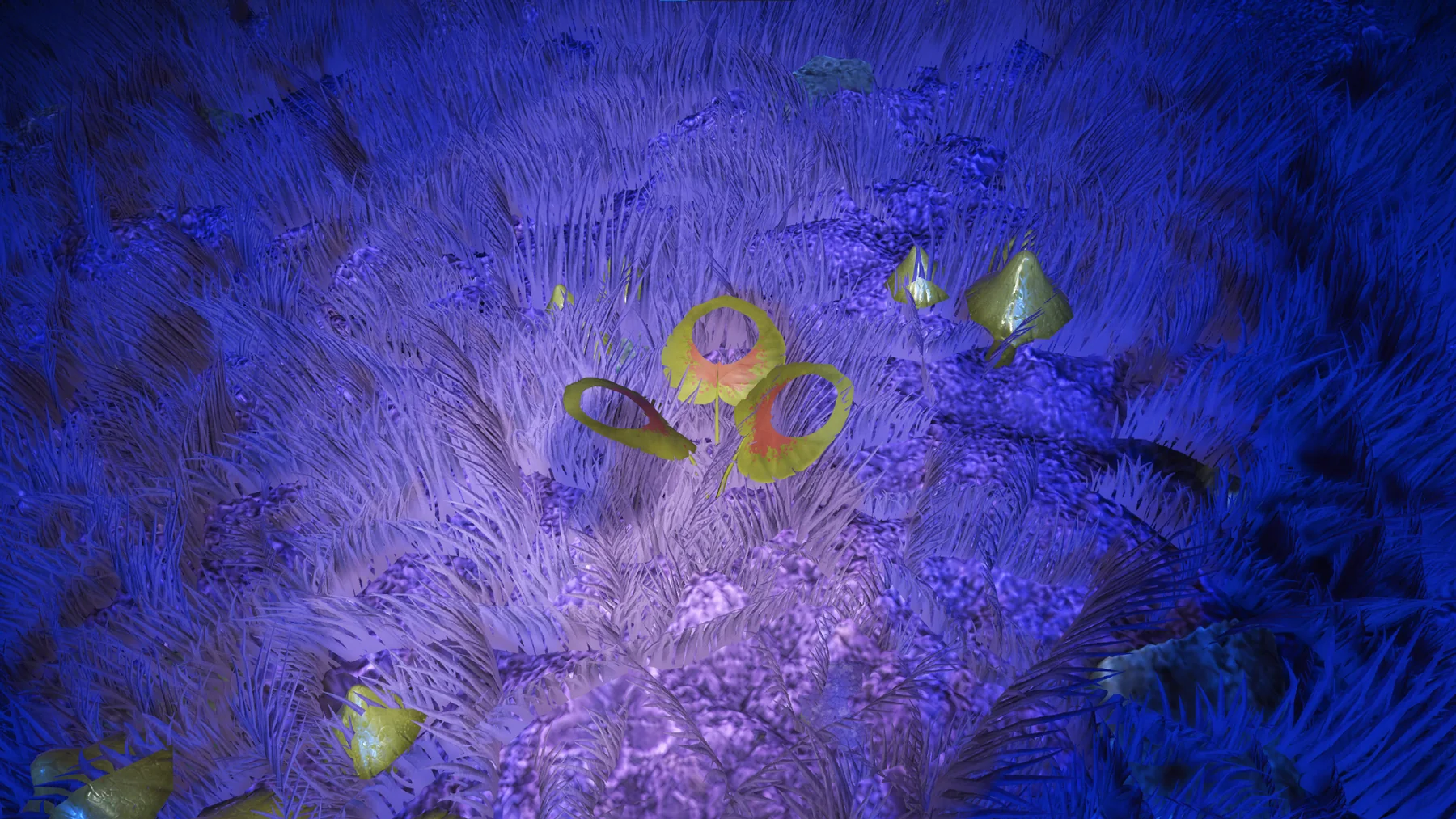
Several slender dark stems support broad yellow-green leaves with large central perforations. Reddish-pink tissue is visible around portions of the openings. The plants rise slightly above dense violet ground cover.
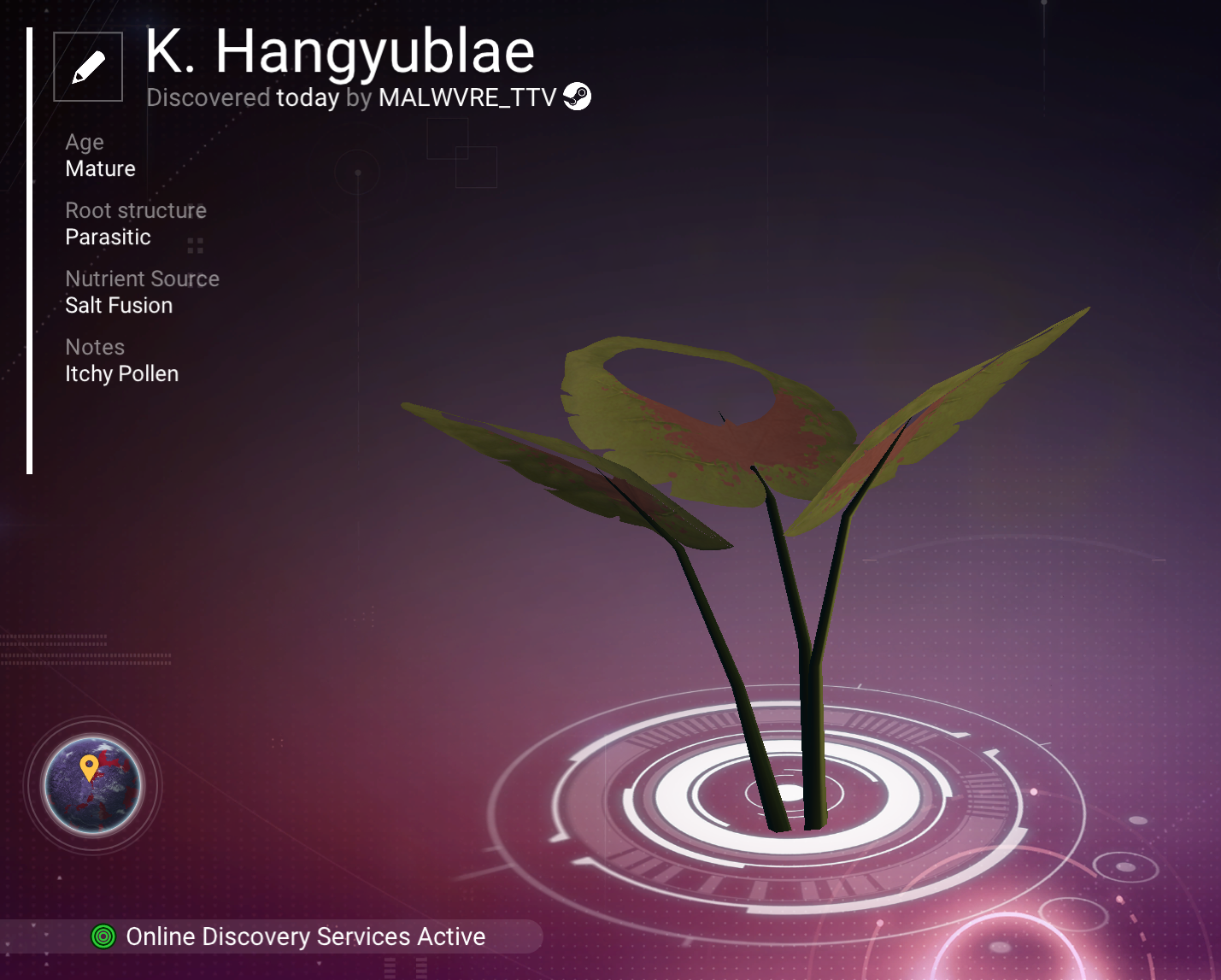
The scanner note “Itchy Pollen” is preserved exactly as recorded. No pollen release or irritation response was directly observed during this survey.
Ecological Context
The scanner classifies the root structure as parasitic and the nutrient source as Salt Fusion. The field photograph confirms that K. Hangyublae grows among dense surrounding vegetation, but no host organism, root connection, or nutrient-transfer mechanism was directly observed.
The preserved evidence supports cataloguing this organism as a distinct botanical record within Serene Basin. Broader ecological relationships remain subject to future observation.
Outstanding Botanical Questions
- Identity of any host organism associated with the scanner-reported parasitic root structure.
- Observable mechanism of the scanner-reported Salt Fusion nutrient strategy.
- Conditions under which the reported itchy pollen is released.
- Whether the leaf perforations remain consistent across mature specimens.
- Distribution of K. Hangyublae beyond Survey Site Alpha.
Archive Significance
K. Hangyublae establishes one authenticated mature botanical record with a parasitic root classification and Salt Fusion nutrient strategy within Serene Basin. Its field imagery and preserved scanner data provide a baseline for comparison with flora recorded at later Ironleaf survey sites.
Preservation Justification
Retained as a scanner-verified botanical record from Survey Site Alpha. Preservation supports future comparison of visible morphology, scanner-reported nutrient strategies, root classifications, and regional distribution across Ironleaf.